cantec despre mine walt whitman comentariu literar cantec despre mine walt whitman comentariu literar
cantec despre mine walt whitman comentariu literar Home News Planets Renderings Objects Drawings Tutorials cantec despre mine walt whitman comentariu literar
The Sun Mercury Venus Earth Mars Jupiter Saturn Uranus Neptune Pluto

Cantec Despre Mine Walt Whitman Comentariu Literar [updated] ❲Top 50 Pro❳

„Cântec despre mine” ( Song of Myself ) reprezintă nucleul capodoperei Fire de iarbă ( Leaves of Grass ) și unul dintre cele mai importante monumente ale liricii universale. Publicat inițial în 1855, poemul a revoluționat structura versificației și a redefinit conceptul de identitate în literatura modernă. Prin intermediul acestui text, Walt Whitman nu se celebrează doar pe sine ca individ, ci transformă propriul „Eu” într-un canal de comunicare pentru întreaga umanitate, natură și divinitate. Teme Principale și Motive Literare 1. Democratizarea Eului și Identitatea Colectivă

Faimosul pasaj despre "firul de iarbă", văzut ca un simbol al regenerării și al egalității.

a revolutionary 52-section poem first published in the 1855 collection Leaves of Grass cantec despre mine walt whitman comentariu literar

Citare pentru citat memorabil

„Cântec despre mine” rămâne un monument literar al optimismului și al libertății absolute. Whitman transformă actul poetic dintr-o simplă căutare a estetismului într-o experiență spirituală directă. Prin dizolvarea barierelor de gen, clasă socială sau rasă, textul propune o viziune profund umanistă în care individul își descoperă propria divinitate privind în interiorul său și reflectându-se în ceilalți. „Cântec despre mine” ( Song of Myself )

Whitman’s work is a literary manifestation of democracy. He breaks down social hierarchies by placing the laborer, the slave, the prostitute, and the president on equal footing [2, 4]. He views the human body with the same reverence as the soul, famously stating that "the scent of these arm-pits arm-pit is aroma finer than prayer" [4, 6]. By celebrating the physical and the mundane, he sanctifies everyday existence. Breaking the Rules of Form

Când un copil îl întreabă „Ce este iarba?” , poetul oferă o serie de definiții metaforice geniale. Iarba devine „stindardul verzi al speranței”, „batista Domnului” sau „părul netăiat al mormintelor”. Acest simbol sintetizează democrația perfectă a naturii (crește pretutindeni, pentru oricine) și nemurirea. Teme Principale și Motive Literare 1

Universul Eulul Absolut: Comentariu Literar al Poemului „Cântec despre mine” de Walt Whitman

Un comentariu comparativ între contemporani?

Tema centrală a poemului este celebrarea sinelui corelată cu identificarea totală cu ceilalți oameni și cu natura. Pentru Whitman, „Eul” nu este unul egoist sau izolat, ci un Eu cosmic, un canal prin care vorbește întreaga umanitate.

Whitman este considerat părintele versului liber în literatura modernă. Lipsit de rimă și de metrică tradițională, ritmul său se bazează pe cadența retorică a textelor biblice (psalmi) și a discursurilor politice. Tehnica Cataloagelor (Enumerația Presupusă)

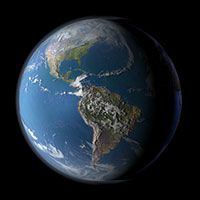
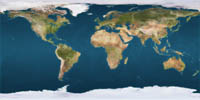
This map is a synthesis between my original earth map, gradient mapping of the USGS DEM information, hand painting, DEM modulation of detail, bathyspheric depth information, and the USGS Ocean clip. Bathyspheric data was used to modulate the color of the water so that deeper areas are a darker blue than shallow areas.
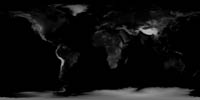
This is pieced together exclusively from the USGS DEM database. It contains landmass elevations only, with the ocean at zero, and the top of Mt. Everest at 255. Use this as a bump map to give the appearance of the Earth's rugged surface features. Some madmen have also used this data in POV Ray as a displacement map on a very finely divided sphere to produce a "true" 3D version of the Earth. The 10K version is VERY large, so make sure you really need that much detail.
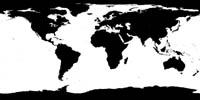
This is derived from USGS DEM data, with the addition of the Arctic ice areas which do not show up on USGS data (since they are not solid land masses.) Use this to control specularity and reflectance of the ocean surface.
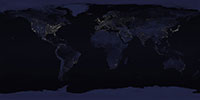
1024 x 512 color image. Very similar to the night lights map as published by NASA on their Blue Marble Page. I took their 30000 x 15000 black and white city lights map, and adapted it with a color table to a colorized version of my earth color map. This comes in 2k, 4k, and 10k versions in color, as opposed to the maximum 2k size of the NASA version of this map (higher resolution versions are available on the paid page only because of their size). Be sure to have a look at the tutorials page for a special rendering tip for using this map.
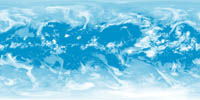
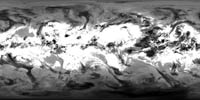
1024 x 512 color image. Based on a mosaic of satellite data, colorized, data errors retouched out, and fixed for seamless wrapping.
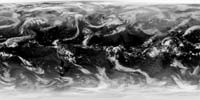
1024 x 512 greyscale image. Based on the same data as the color map, but leveled for the purpose of transparency mapping.

4096 x 2048 greyscale image. Built up out of real satellite imagery based upon a tutorial Dean Scott of Silicon Magic has posted. This is posted in JPEG2000 format. You need a special Photoshop plug-in to make use of jp2 images. I've thoughtfully provided a link:

JPEG 2000 Plugin from Fnord.

Cantec Despre Mine Walt Whitman Comentariu Literar [updated] ❲Top 50 Pro❳

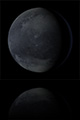
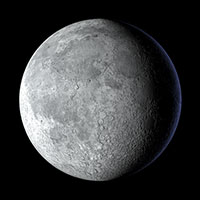
The Moon is a tricky planetoid to render. It has a very distinctive albedo which remains constant across its lit side, regardless of the angle of the surface to the sun. Therefore, standard rendering lighting models do not apply, as they always have a characteristic drop off in intensity as the angle of incidence to the light source increases. In Lightwave, there is an option to use a "non-Lambertian" lighting model on a surface setting. In previous versions of Cinema4D, you had a contrast control in the lighting setup. More recent versions of Cinema4D feature an Oren/Nayar illumination model in the lighting setup which allows you to simulate the lighting properties of "rough" surfaces. This is the method I used on the same pictured here.

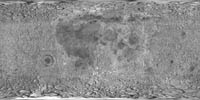
This map is based on a mosaic of satellite data, retouched for visible mosaic seams and for problems with the wrapping seam. Since this image contains highlight and shadow information independent of the location of your light source (inevitable because of how the moon is illuminated by the sun), you'll need to be careful how you light this so you don't break the illusion.

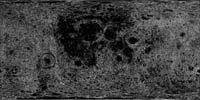
This map is my attempt to derive bump information from the above map. I did a high-pass filter operation to find all the edges of the craters, and then curved the result so that blacks and whites were white, and mid-tones were black. The results came out pretty well, as you can see from the sample image above.


this site works
best on Firefox:


website design © 2006 james hastings-trew